
-
8 Insights – 8 African countries
Dynamic Africa
Ethiopia
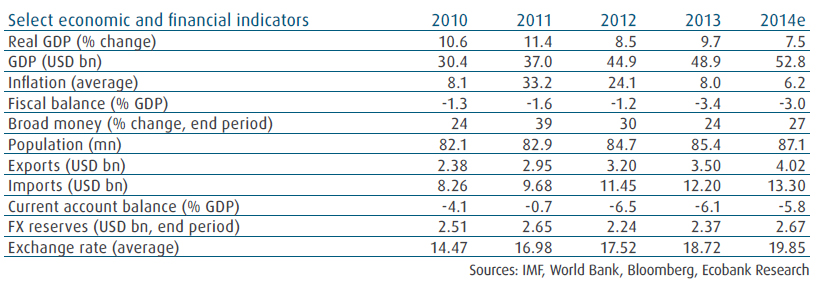
Growth in Ethiopia remained robust at nearly 10% in 2013. Despite a large fall in coffee prices and supply bottlenecks, strong growth was driven by higher agricultural output and increased construction and other services activities, in part reflecting government investment, global commodity demand, and incentives for specific export sectors. -
ETHIOPIAGrowth in Ethiopia remained robust at nearly 10% in 2013. Despite a large fall in coffee prices and supply bottlenecks, strong growth was driven by higher agricultural output and increased construction and other services activities, in part reflecting government investment, global commodity demand, and incentives for specific export sectors. Inflation slowed from a peak of 40% in July 2011 to 7% in June 2013, helped by stabilising food prices, which significantly lowered negative real interest rates. However, high interest rates on private sector activity remain a drag on growth, as does stagnation in Europe, an important source of export demand.
Nonetheless, inflation remains elevated largely due to a distorted monetary policy, driven by heavy monetary financing of the public sector. Fiscal policy remained reasonably prudent last year. The revenue-to-GDP ratio is likely to have fallen to around 1 percentage point to 13% in 2012-13 (July-July) as non-priority expenditure was reduced. However, the fiscal stance for the consolidated public sector (including public enterprises) was considerably more expansionary.
As a result, the fiscal deficit, including grants, is estimated to have widened to over 3% of GDP. The current account deficit was largely unchanged at over 6% of GDP, reflecting a weak trade balance. Progress in export diversification was limited and export performance deteriorated due to a fall in prices and weak demand for Ethiopia’s exports. Meanwhile, continued infrastructure and industrial investment and higher fuel importation contributed to a large increase in imports.